From that and from the inductive assumption, we have a thesis in the instance of the sequence of (k+1) events. By the terms of induction, the statement is true for any sequence of events of n elements. ♦
The statement presented above is very practical, if we assume that the elementary events from the sample space Ω are equally probable and that the sample space is finite.
Let Ω = {w1, w2, ..., wn} and let P(wi) = p for a certain p, i.e. all the elementary events are equally probable.
By the terms of the previous statement we have:
P( Ω) = P({w1, w2, ...wn}) = P({w1} ∪ {w2} ∪ ... ∪ {wn} ) = P(w1) + P(w2) + ... +P(wn) = n*p = 1
Hence p = 1/n.
Let's have any event A = {wi1, wi2, ...w ik}, which has k favorable elementary events of the sample space Ω . Then, by the terms of the definition 13.4.1 and previous consideration, P({wi}) = 1/n for all i =1,2,..n, and
P(A) = P({wi1, wi2, ...wik}) = P({wi1} ∪ {w i2} ∪ ... ∪ {w ik} ) = P(wi1) + P( wi2) + ... +P(w ik).
Finally P(A) = k/n.
Theorem 13.4.1
Probability of the event A ⊆ Ω is a quotient of the number of elementary events favorable to the event A and the number of elementary events of the considered finite sample space Ω, if the elementary events are equally probable, i.e.

The formula included in the above theorem is called the classical definition of probability, and it was formulated by Pierre Laplace.
The use of this formula will be demonstrating on examples. In all cases we assume that the elementary events are equally probable (i.e. for example during the roll of a die we are using only a "fair" die) .
Example 13.4.1
Let Ω be the sample space in rolling a
pair of dice trial. The sample space consists of 36 events, see Figure
13.2.1. Let's consider the events A, B, C: A ="6 received at least
once", B = "the sum of pips is 7", C = "product of pips is an even
number". As the event A has 11 favorable elementary events, the event B
has 6 favorable elementary events, the event C has 27 favorable
elementary events, then
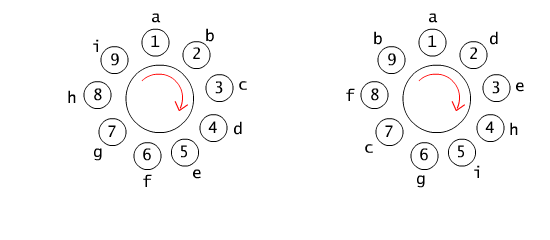
Fig. 13.4.2 The arrangement of 9 people at a round table.
Example 13.4.2
9 people {a,b,c,..g,h,i} sit at a round table on nine chairs marked with numbers 1,2,3...9. What is the probability that two persons, a and b, sit next to each other?
The sample space is a set of all possible arrangements of 9 people on 9 chairs. It is the same number as the number of permutation of the set of 9 elements, so 9! If we choose a place for person a, then person b has to take an adjacent seat on the left or on the right. There are 9 possible arrangements for the situation (ab) and 9 arrangements for the situation (ba). The rest of the people can sit anywhere, i.e. 7! possible arrangements for the remaining 7 people. Finally, the probability is 2(9*7!/9!)=1/4.
Example 13.4.3
There are 9 balls in the box marked with numbers from 1 to 9. We draw two balls (sampling without replacement). The first one stands for the number of units, the second one stands for the number of dozens. What is the probability of the event A = "an even number obtained"?
If for the first time we draw 4, and 6 for the second, then our result is 6*10 + 4 = 64, and if for the first time we draw 1, and 2 for the second, then our result is 21.
The sample space Ω = {(k,l) : k,l ∈ {1,2,...9} and k ≠ l}. | Ω| = 9*8 =72.
All those situations are favorable to the event A, where the drawn number of units is even, which means those where the first number drawn is even. Hence A consists of the elementary events
(2,x), for x ≠ 2, (there are 8 such events),
(4,x), for x ≠ 4, (there are 8 such events)
(6,x), for x ≠ 6, (there are 8 such events)
(8,x), for x ≠ 8 (there are 8 such events).
So P(A)= 4*8/(9*8) = 4/9.
Example 13.4.4
We toss a coin 10 times. What is the probability that during those 10 tosses tails will be obtained exactly 4 times?
The sample space is a set of sequences with the values of T - tails and H - heads. There are as many such events as there are different functions from the set of 10 elements into the set of 2 elements (i.e. as many as different binary sequences of ten elements), which is 210. All the events where tails appears 4 times in a sequence and heads - the remaining 6 times are favorable to the event A. The position of those four tails can be any of the set of 10 elements. There are as many of them as the four-elements subsets in a set of 10 elements, i.e. (10 nad 4). Hence, the probability of the considered event is 210/1024.
Question 13.4.2: Let's consider the trial described in the example 13.4.3. What is the probability that the number drawn is divisible by 3?
| « previous section | next section » |