13.1 Sample space
Probability calculus, like all the other mathematical theories,
starts with certian primitive notions which are not defined (see 7.6).
An example of such notion here is an elementary event. An elementary
event is a possible outcome of an experiment. The set of all elementary
events in a certain experiment is called a sample
space and usually marked with the Ω symbol.
The sample space of a random experiment plays the role of the universal
set when modeling the experiment. The notions of an elementary event
and a sample space will be explained
using practical examples.
Example 13.1.1
- Let the trial be rolling a die. We look at the number of pips at
the upper face of a die. Elementary event is receiving a certain number
of pips. Obviously, the possible rolls are 1, 2, 3, 4, 5 or 6 pips.
Hence the sample space Ω
contains, in this trial, 6 events which can be identified with the
number of pips Ω = {1, 2, ...,6}.
- Let the trial be a toss of a coin. We look at the top side of a
coin and we record a fact whether it is heads or tails. This time there
are only two elementary events: heads or tails. We mark those events
accordingly H and T. The sample space is in this case a set of 2
elements, Ω = {H, T}.
- Let the trial be a toss of two coins. Just like in the previous
example the value of a coin is irrelevant and we only check its upper
surface. Elementary events are the ordered pairs (x, y), where x,y ∈
{H,T} and where x indicates the first coin and y - the second one. The
sample space consists of four events (H, H), (H, T), (T, H), (T, T).
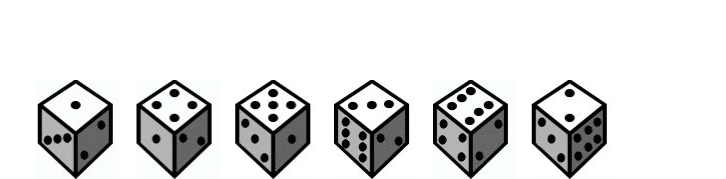
Fig. 13.1.1 Examples of events in a rolling a die trial.
Example 13.1.2
- During a ski jump competition each contestant jumps twice. The
result of each jump is treated as a random event. The length of a jump
is measured with an accuracy of 0.5 m. Moreover, we know that the
maximum length
of a jump is 140 m. The set of elementary events can be identified with
the ordered pairs (x,y), where x indicates the length of the first jump
and y - the length of the second one. Hence Ω
= {(x,y): x length of the first jump, y length of the second jump}.
Both x and y can be any of 0, 0.5, 1, 1.5, 2,... 135.5, 140. As there
is 281 numbers in this set, | Ω
| = 281*281. The sample space contains 78961 events.
- The final grade of a course depends on the sum of points received
from two tests and an exam. The maximum number of points to receive is
20 for each test and 60 at the exam. The sample space Ω
in this case can be the set of threes (x,y,z), where x, y are the
points from the tests and z - from the exam. We have Ω ={(x,y,z) ∈ N3:
x ≤ 20, y ≤
20, z ≤ 60}. This sample space consists of
21*21*61 elements.
Question 13.1.1 How many elements are there in the sample
space if the trial is rolling 3 dice?
Question 13.1.2 Specify the sample space of a trial which is
painting a tricolour flag (three stripes) using three different colours
a, b, c.
-----
Check the answer -----