| « previous section | next section » |
Definition 13.2.1
Let Ω be a sample space. Any subset A of the sample space is called an event. We say that the event A has occured if the result of a trial is an elementary event which is a member of the set A.
Example 13.2.1
In a rolling a die trial (see example 13.1.1(1)) elementary events consists in receiving 1, 2, ... or 6 pips, Ω = {1, 2, 3, 4, 5, 6}.
Let Ω be a sample space and A an event in this space, A ⊆ Ω. If A = {a1, a2, ..., an}, then elementary events a1, a2, ..., an are called events favorable to the event A.
We say that the event A is certain if A = Ω, and we say that the event is impossible if A = ∅. The certain event is absolutely guaranteed to happen every time, contrary to impossible event, that absolutely cannot happen.
Note. The sample space is not always finite and the events are not always the finite subsets of this space. In this lecture however, we will only consider a descrete case, all considered trials will have a finite sample space and all considered events will only have a finite number of the favorable events.
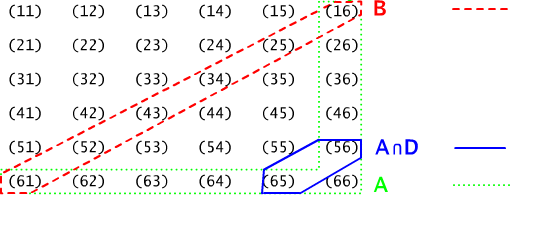
Fig. 13.2.1 The sample space in a trial of rolling two dice.
The event A=" 6 received at least once", B= "the sum of pips is 7", and
the intersection of the events A and D, where D= "5 received at least
once" have been marked.
Example 13.2.2
The trial is rolling two distinguishable dice (marked for example as die number 1 and die number 2), we have the sample space containing of 36 elements Ω = {(i,j) : i, j = 1, 2, ...6} where, obviously, (i,j) is an elementary event indicating that i pips have been obtained after the first roll and j pips after the second, see Figure 13.2.1.
Question 13.2.1 How many elementary events are there favorable to the event "the number of pips on the first die is a divisor of the number of pips on the second die"?
| « previous section | next section » |